Mazo vs ChatGPT for go-to-market strategy: what each is good for
How to get a good GTM strategy out of ChatGPT
ChatGPT and Claude can give you a solid go-to-market strategy. Most weak answers come from a weak brief: "How do I get customers for my SaaS?" gets you a generic list of channels. Give it the same facts a good advisor would ask for, make it question you before it plans, and make it argue with the plan before you commit to it.
1. Give it the context an advisor would ask for
- Product and what it replaces: what it does, and what customers use today instead (a spreadsheet, an agency, a competitor, nothing).
- ICP: company type and size, the buyer's role, and the event that makes them start looking.
- Price: what one customer pays you a year (your ACV) and how you charge.
- Stage: MRR and number of paying customers, even if both are zero.
- Channels tried, with numbers: "LinkedIn posts for 6 weeks, 2 demos" beats "LinkedIn didn't work".
- Constraints: hours a week you can spend on go-to-market, budget, and who else is on the team.
- The one decision you're trying to make right now.
Paste this in once and reuse it. In ChatGPT you can keep it in a project's instructions or files; in Claude, in a project's instructions or knowledge base. That way every new chat in the project starts with it and you don't have to paste it again.
2. Copy-paste prompts
You are a go-to-market advisor for early-stage B2B SaaS. Here is my situation:
- Product: [what it does, and what customers use instead today]
- ICP: [company type and size, buyer role, the event that makes them start looking]
- Price: [what one customer pays per year, and how I charge]
- Stage: [MRR, number of paying customers]
- Channels tried: [channel, what I did, result in numbers]
- Constraints: [hours a week for go-to-market, budget, team]

Before you recommend anything, ask me the questions you need answered to find the single biggest thing holding my growth back. Ask them one at a time. Don't give me a plan until I've answered.
Based on everything I've told you, give me a 90-day go-to-market plan for my stage. Maximum 6 moves, in order.

For each move: what I do this week, why it comes before the next move, and a pass/fail test with a number and a date ("if X happens by [date], move on; if not, change Y").

Then tell me what I should NOT do yet, and why.
Argue against this plan. Assume it has failed 90 days from now and give me the three most likely reasons, starting with the one I'll least want to hear.

For each reason, point to the specific number or assumption in what I told you that it rests on. Tell me which of my statements are evidence and which are guesses. Don't soften it, and don't end with reassurance.
3. Keep it honest week to week
- Ask for one move, not ten. "What's the one thing I should do this week?" is easier to act on than a list.
- Bring the result back. Next week, paste the numbers and ask: "Did this pass the test? What's the next move, and why?"
- Update your context when it changes. New MRR, a new price, a channel you've dropped. Otherwise the advice is built on last month's business.
- Watch for agreement. If every answer confirms what you already planned, run prompt 3 again.
Where general AI falls short for running go-to-market week to week
None of this is about intelligence. ChatGPT and Claude are general-purpose assistants, and the gaps below come from how they're used, not from what they know.
- It answers the question you asked, not the one you should have asked. Ask "should I add a free plan to get more signups?" and you get the pros and cons of free plans, when the real problem might be that trial users never come back.
- It tends to go along with your framing. Unless you ask it to argue, you mostly get your own plan back, better written.
- Context is your job. ChatGPT and Claude both have memory and projects, so set up well they can carry what you've told them across chats. But what they know is whatever you've told them, and nobody checks that your MRR, price and last month's results are current before the next answer.
- It doesn't hold you to what you committed to. A chat waits for you. Unless you set up a reminder yourself, nothing comes back in a week to ask whether the cold emails got replies.
- No stage model or pass/fail tests unless you ask for them. The advice can be good in general but wrong for your stage, like running three channels before you have ten paying customers, and it rarely comes with a number that tells you whether it worked.
You can work around every one of these with the prompts above and some discipline. A dedicated advisor builds that discipline in.
What that looks like in Mazo
Mazo is an AI go-to-market advisor for B2B SaaS founders, €0–€1M ARR. It builds your go-to-market plan from where you are today, then runs it with you every week.
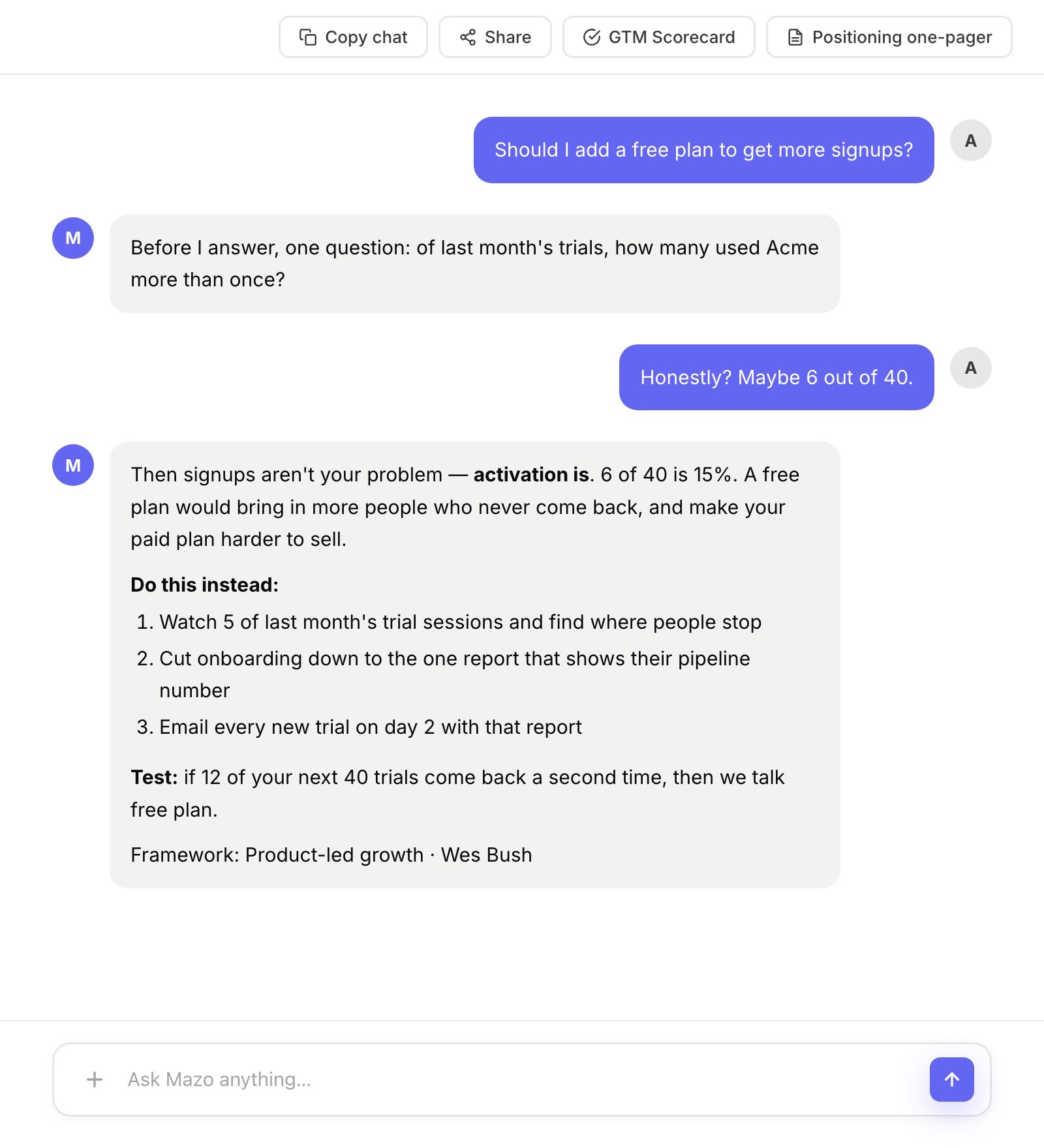
- It asks before it advises. One focused question at a time until it knows your product, buyer, stage and what's stuck, and it doesn't re-ask what it already knows.
- It pushes back. When your assumption is wrong, it says so, like "signups aren't your problem, activation is".
- It remembers your founder facts. Your ICP, ACV, MRR, channels tried and constraints are saved to your account and used in every session.
- It follows up. Moves that need a real-world test get a metric, a threshold and a check-in date, and Mazo emails you when the test is due. A new session opens by asking whether you did what you committed to last time.
- It keeps you on one move. A 90-day plan of six to eight moves for your stage, each with why it's next and the framework behind it. Mark one done and the next comes up.
Mazo vs ChatGPT or Claude, side by side
| ChatGPT or Claude | Mazo | |
|---|---|---|
| Starting point | Whatever you type, plus any context you've added to a project or it has kept in memory | A go-to-market intake: what you sell, who buys, MRR, ACV, what's stuck. Or drop in your website and a doc. Then a diagnosis of where you are |
| Questions it asks | Answers what you asked; asks clarifying questions if you tell it to | Asks one focused question at a time before recommending, and never re-asks what it already knows |
| Pushback | When you ask for it ("argue against my plan") | By default: it's built to say when your assumption is wrong |
| GTM playbooks | Broad general knowledge; names frameworks if you ask | Named operator frameworks applied to your stage: April Dunford on positioning, Kyle Poyar on pricing, Wes Bush on product-led growth, Brian Balfour on channel fit, Aaron Ross on outbound, and more. Every recommendation names its framework |
| Stage model | None built in | Stage diagnosis from pre-product-market fit to €1M ARR and beyond, with red flags for each stage |
| Plan and weekly follow-up | A plan if you ask for one; follow-up happens when you come back with results | A 90-day plan run one move at a time, a pass/fail test Mazo checks back on by email, and a Monday check-in with your next move |
| Your context across sessions | Memory and projects can carry it; what goes in and stays current is up to you | Founder facts (ICP, ACV, MRR, channels tried, constraints) saved to your account, plus the last thing you committed to |
| Tools and templates | Anything you can prompt for | Fifteen go-to-market tools, including a First 10 Customers Plan, Willingness-to-Pay Test, Positioning Stress Test, Pricing & Packaging Teardown and Outbound Sequence Generator |
| Price | The plan you already have | €99 a month or €990 a year; 14-day free trial, no credit card |
| Best for | Drafting, research, one-off questions, and founders who'll run their own process | B2B SaaS founders, €0–€1M ARR, who want a plan and an advisor to run it with every week |
ChatGPT or Claude is the better choice when…
- You need a one-off: rewrite a cold email, summarise interview notes, draft a job post.
- You don't sell B2B SaaS. Mazo is built only for that.
- You already have a clear plan and someone holding you to it, and you just need a fast writer and analyst.
- You're happy to keep your context current, run the prompts above and bring your results back every week yourself.
- €99 a month isn't in the budget right now. Use the prompts on this page and our free tools.
Mazo is the better choice when…
- You're a B2B SaaS founder, pre-revenue to €1M ARR, running go-to-market yourself.
- You don't know what to ask, and want an advisor that does.
- You keep re-deciding your plan every Monday.
- You want every move tested with a number before you scale it.
- You'd rather not rebuild your context and your discipline in a blank chat each week.
Or use both
They aren't exclusive. Use ChatGPT or Claude for drafting and research, and Mazo for the plan and the weekly calls on what to do next.
Weighing up other kinds of help? Read fractional CMO vs Mazo, or start with our go-to-market strategy guide for B2B SaaS, from €0 to €1M ARR.
Who wrote this

Madalena Rugeroni built Mazo. She's an ex-Googler, a startup advisor and investor, and runs a portfolio of internet companies. Before that, as Head of Growth at Amplemarket, she scaled a B2B SaaS to $10M ARR. LinkedIn
Questions founders ask
Can ChatGPT create a go-to-market strategy?
What should a ChatGPT prompt for GTM strategy include?
Does ChatGPT remember my business between chats?
How is Mazo different from ChatGPT or Claude?
How much does Mazo cost?
Get a plan, and an advisor to run it with
Mazo builds your go-to-market plan from where you are today, then runs it with you every week.
Start 14-day free trial Not ready? Try the free go-to-market tools, no account needed →Sources. ChatGPT and Claude features as described in their providers' help centres (checked 15 September 2026):
- OpenAI Help Center, "Memory FAQ": saved memories and chat history, and how to turn them off.
- OpenAI Help Center, "Projects in ChatGPT": projects that hold chats, files and instructions.
- Claude Help Center, "Use Claude's chat search and memory to build on previous context".
- Claude Help Center, "What are projects?": knowledge base and project instructions.
Features and plans change; check the providers' pages for what's current. Frameworks are published methodologies credited to their authors; Mazo is not affiliated with or endorsed by them, or by OpenAI or Anthropic.